The 26% Drop in Viewership and the Growing Fear That Cricket Is Becoming Only a Batsman’s Game
There was a time when the Indian Premier League felt like a festival that stopped the nation.
Families planned dinners around matches. Streets emptied during Super Overs. Children copied the bowling actions of Lasith Malinga, Sunil Narine, and Jasprit Bumrah in narrow lanes. A great yorker received the same applause as a towering six.
But in 2026, the mood feels different.
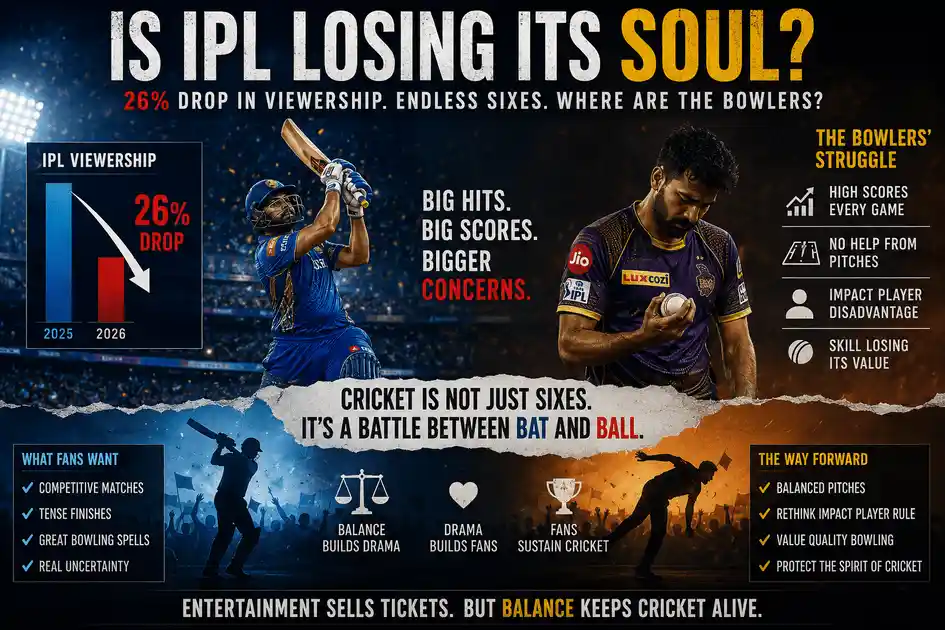
Reports of a 26% decline in IPL viewership have triggered a serious conversation around the future of the tournament. Fans are no longer asking only who will win the trophy. They are asking a much deeper question:
Has the IPL slowly become a game designed only for batsmen?
And if that is true, then another uncomfortable question follows:
Are we sacrificing the soul of cricket in the race for money, entertainment, and endless sixes?
Cricket Was Always About Balance
The beauty of cricket has never been just about runs.
It has always been about the contest.
A fast bowler steaming in with the new ball under lights.
A spinner trapping a batter in flight and deception.
A captain building pressure over several overs.
A batter surviving tough spells before launching an assault.
That balance created drama.
But modern IPL cricket increasingly feels tilted heavily toward one side.
Today, totals of 230 or even 250 no longer shock anyone. Flat pitches, tiny boundaries, impact-player rules, and batting-friendly conditions have changed the very nature of the contest. Bowlers often walk into games already defeated before the first ball is bowled.
A mistimed shot still clears the ropes. Yorkers disappear into the stands. Even good deliveries are punished.
For many fans, the thrill of uncertainty is fading.
Bowlers Are Becoming Supporting Characters
The saddest part of the modern T20 era is that bowlers are no longer treated as central figures in the spectacle.
In earlier IPL seasons, bowlers shaped tournaments.
Rashid Khan could choke an innings with four overs of mystery.
Bhuvneshwar Kumar could swing the new ball under pressure.
Dwayne Bravo mastered slower balls like an artist.
Now, even elite bowlers regularly finish with figures like 4-0-52-1 and are expected to “accept the conditions.”
That is dangerous for the game.
Young cricketers watching the IPL may slowly stop dreaming of becoming bowlers. Why spend years mastering swing, seam, and spin when the format gives so little protection to the craft?
Cricket risks becoming simplified into one repetitive formula:
Big bat. Bigger shot. Bigger score. Repeat.
And repetition eventually creates fatigue.
Are Fans Getting Tired of Endless Run-Fests?
For years, the IPL believed that more runs automatically meant more entertainment.
Initially, it worked.
A 200-plus score once felt extraordinary. It created highlights that spread across social media within minutes. Sponsors loved it. Broadcasters loved it. Franchise owners loved it.
But there is a point where excess stops feeling special.
If every second game becomes a batting exhibition, then nothing feels memorable anymore.
A tense 145-run defense can often produce more drama than a casual 250-run chase.
Why?
Because tension creates emotion.
Fans remember pressure. They remember collapses. They remember bowlers defending 12 runs in the final over. They remember impossible spells under pressure.
Cricket without pressure becomes predictable entertainment.
And predictable entertainment eventually loses viewers.
The reported drop in viewership may not simply be about streaming platforms or changing habits. It may also reflect emotional exhaustion. Fans want competition, not batting practice.
The Impact Player Rule Changed the DNA of the Game
One of the biggest debates around modern IPL cricket is the Impact Player rule.
The rule was introduced to add tactical depth and excitement. Instead, many believe it tilted the balance even further toward batting.
Teams now play with almost endless batting depth. A collapse rarely matters because another power-hitter is always waiting.
Earlier, captains had to think carefully about team balance. Choosing an extra batter often meant sacrificing a bowler. That risk created strategy.
Now, the consequences are reduced.
The result?
Aggression without fear.
And sport without fear loses its emotional edge.
Even several cricketers and experts have quietly expressed concerns that the rule is harming all-rounders and reducing the tactical richness of T20 cricket.
Is IPL Becoming a Threat to International Cricket?
This may be the biggest concern of all.
The IPL is no longer just a tournament. It is now the center of the cricket economy.
Young players worldwide increasingly prioritize franchise leagues over domestic red-ball cricket. National boards fear player burnout. International calendars are constantly adjusted around T20 leagues.
And financially, no tournament comes close to the IPL.
That power brings influence.
The danger is not that the IPL exists. The IPL has done extraordinary things for cricket:
- It created global superstars.
- It improved player fitness standards.
- It gave uncapped players life-changing opportunities.
- It revolutionized sports broadcasting and fan engagement.
But when one format becomes too dominant, the ecosystem around it begins to weaken.
Test cricket, especially, survives because of patience, nuance, and balance between bat and ball. If young audiences grow up consuming only ultra-aggressive batting spectacles, their connection to longer formats may slowly disappear.
That would be a tragedy.
Because cricket’s greatness lies in its variety.
A brutal T20 finish.
A tense ODI chase.
A five-day Test match battle.
Each format protects a different part of the game’s identity.
The Business of Cricket vs The Spirit of Cricket
There is another uncomfortable truth behind this debate.
The IPL is not only a sporting product anymore. It is a massive entertainment industry.
Broadcasters want high-scoring games because they create clips, headlines, and social media engagement. Sponsors want visibility. Franchises want excitement. Algorithms reward sixes more than disciplined spells.
Money naturally pushes the game toward spectacle.
But history shows that every sport faces danger when entertainment completely overtakes competition.
Fans may enjoy fireworks for a while. Yet deep down, sports lovers always return for authenticity — for real contests, real tension, and real uncertainty.
That is why a fiery spell from Dale Steyn still lives in memory.
That is why MS Dhoni defending impossible situations became iconic.
That is why low-scoring thrillers often remain unforgettable.
Emotion comes from struggle.
Not just from sixes.
Can the IPL Fix This?
Absolutely.
The IPL is still one of the greatest sporting leagues in the world. But it may need course correction.
Possible changes could include:
- Preparing more balanced pitches.
- Giving bowlers slightly larger boundaries.
- Reconsidering the Impact Player rule.
- Encouraging surfaces that reward skill and variation.
- Protecting the value of quality bowling spells.
Fans do not hate aggressive batting.
They simply want balance restored.
They want to feel that a great delivery matters again.
The Future of Cricket Depends on Balance
Cricket has survived for generations because it constantly evolved without losing its core identity.
But every evolution has a limit.
If the game becomes too one-dimensional, audiences eventually notice. And perhaps the 2026 viewership decline is the first real warning sign.
The IPL does not need fewer stars, fewer sixes, or less excitement.
It simply needs to remember what made cricket magical in the first place:
The battle between bat and ball.
Without that battle, cricket risks becoming spectacle without soul.
And that would be the biggest loss of all.