The story of T20 cricket is not one of ancient tradition, but of modern marketing and a desperate need to save the game’s popularity at the domestic level.
1. The Catalyst: A Decline in Interest
In the late 1990s and early 2000s, English domestic cricket was struggling. The England and Wales Cricket Board (ECB) noticed a significant dip in crowds and sponsorship for their long-form and 50-over matches. Young audiences, in particular, found the traditional formats too slow for their fast-paced lifestyles.
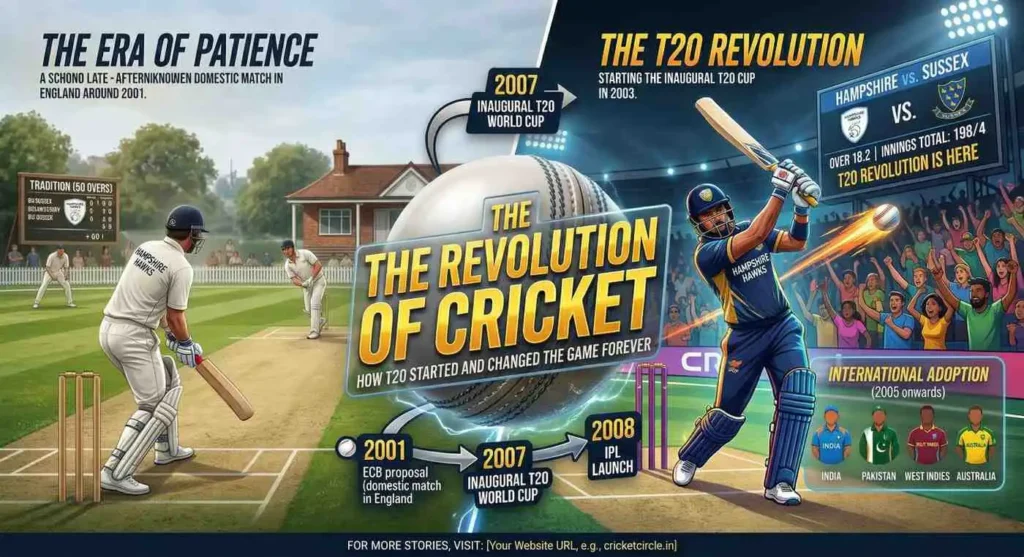
To combat this, the ECB’s marketing manager, Stuart Robertson, proposed a 20-over-per-side format in 2001. The goal was simple: a game that started in the evening and finished in time for fans to get home, lasting about the same duration as a movie or a football match.
2. The First Official Match (2003)
After much debate—and some resistance from traditionalists—the first official Twenty20 matches were played on June 13, 2003, as part of the Twenty20 Cup in England.
- The First Match: The inaugural game took place between the Hampshire Hawks and the Sussex Sharks.
- The Result: It was an instant hit. The shortened format encouraged aggressive batting, risky bowling, and athletic fielding, which captivated the live audience.
3. Transition to the International Stage (2005)
While it was initially intended as a domestic gimmick, the format’s popularity forced the International Cricket Council (ICC) to take notice.
The first-ever Men’s Twenty20 International (T20I) was played on February 17, 2005, between Australia and New Zealand at Eden Park in Auckland. Interestingly, the players didn’t take it very seriously at first; they wore 1980s-style retro uniforms and some even sported fake mustaches, treating it more like an exhibition than a competitive match.
4. The 2007 T20 World Cup: The Turning Point
The format truly “arrived” during the inaugural ICC World Twenty20 in 2007, hosted by South Africa.
Key Moment: India’s thrilling victory over Pakistan in the final changed the landscape of the sport forever.
India’s massive market suddenly embraced the format, leading to the creation of the Indian Premier League (IPL) in 2008. The IPL combined cricket with Bollywood glamour and private ownership, making T20 the most lucrative version of the sport.
Key Differences from Traditional Cricket
T20 introduced several rules designed to keep the game moving and favor the “big hitters”:
- Powerplays: Only two fielders are allowed outside the circle for the first six overs.
- Free Hits: If a bowler delivers a front-foot no-ball, the next delivery is a “free hit” where the batter cannot be out (except for a run-out).
- Bowl-outs/Super Overs: Introduced to ensure a winner is decided even if the scores are tied.
Summary Table: Milestones of T20 Cricket
| Year | Event | Significance |
|---|---|---|
| 2001 | Proposal by Stuart Robertson | The blueprint for the 20-over format was created. |
| 2003 | First Twenty20 Cup (UK) | Proved the format was commercially viable. |
| 2005 | First Men’s T20I | Australia vs. New Zealand marked the start of international T20. |
| 2007 | First T20 World Cup | Global adoption, led by India’s historic win. |
| 2008 | Launch of the IPL | Turned T20 into a multi-billion dollar industry. |
Today, T20 is the primary engine for cricket’s expansion into non-traditional markets like the USA and Europe, proving that a format born out of a marketing crisis became the savior of the sport.