
Once upon a time in One Day International cricket, a century was built brick by brick.
Batsmen took their time, wore down bowlers, and only hit top gear in the final overs. Scoring a hundred meant survival first, style later.
Then the game changed.
Bigger bats, shorter boundaries, flat pitches and the rise of T20 cricket turned that old marathon into a full-throttle sprint. Suddenly, a century was no longer about patience — it was about pure destruction.
From Shahid Afridi’s teenage thunderbolt to AB de Villiers’ superhuman masterpiece, this is how the fastest hundred in ODI cricket became the most thrilling race in the sport.
When Speed Was Unthinkable
In the 1970s and 80s, even reaching a hundred in under 100 balls felt outrageous.
Legends like Vivian Richards and Zaheer Abbas attacked bowlers in ways fans had never seen, but the mindset was still traditional. You built an innings. You respected good bowling. You waited for loose balls.
A strike rate of 80 was considered daring.
The idea of a century in 40 balls belonged to science fiction.
Then a teenager from Pakistan walked out with a borrowed bat… and changed everything.
Shahid Afridi: The Earthquake (1996)
October 1996.
Nairobi.
Pakistan vs Sri Lanka.
Shahid Afridi, just 16 years old, was playing only his first ODI innings. No one expected fireworks.
What followed was pure chaos.
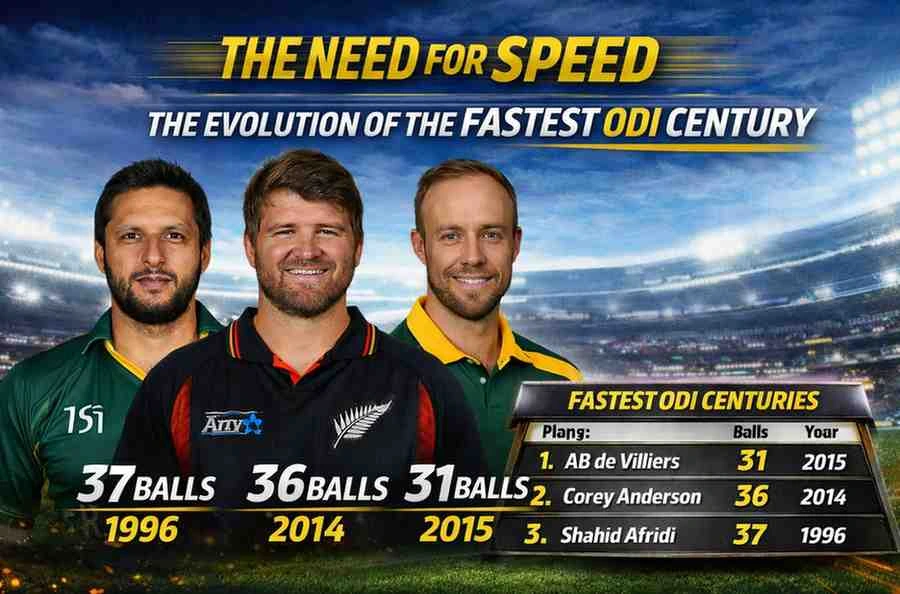
Afridi smashed the Sri Lankan attack all over the park, launching sixes with fearless abandon. In just 37 balls, he reached his century — the fastest in ODI history.
Cricket had never seen anything like it.
This wasn’t clever batting.
This wasn’t calculated aggression.
This was raw, unapologetic power.
Afridi’s 37-ball hundred stood for nearly 18 years, becoming one of the most iconic records in the game. Bowlers feared it. Fans worshipped it. Young batters dreamed of beating it.
For a long time, it felt untouchable.
Corey Anderson Breaks the Wall (2014)
New Year’s Day, 2014.
Queenstown, New Zealand.
In a rain-shortened ODI against West Indies, Corey Anderson walked in with a simple mission — hit hard, hit fast.
He did much more than that.
Anderson tore into the Caribbean attack, raining down towering sixes and brutal drives. In just 36 balls, he crossed 100, breaking Afridi’s legendary record by a single delivery.
After 18 years, the fastest ODI century had finally fallen.
It wasn’t just a new record — it was a sign of a new era. T20 cricket had arrived, and ODI batting was now following its fearless rhythm.
But the story was not done.
Because what came next was something cricket still struggles to explain.
AB de Villiers: Perfection at Full Speed (2015)
January 18, 2015.
Johannesburg.
South Africa vs West Indies.
AB de Villiers walked out to bat — and within minutes, the game belonged to him.
Using every inch of the bat and every angle of the field, AB began to play shots that felt illegal. Scoops over fine leg. Reverse hits past point. Straight drives that broke the sound barrier.
He reached his fifty in 16 balls.
The crowd was already stunned.
Then he went further.
In just 31 balls, AB de Villiers reached his century — the fastest hundred in ODI history. Not just a new record, but a whole new level of batting.
He finished with 149 off 44 balls, hitting 16 sixes, turning a 50-over match into a 20-over spectacle.
It wasn’t brute force alone.
It wasn’t just innovation.
It was batting genius at its peak.
As fans joked that day, AB wasn’t playing cricket — he was playing something beyond it.
Fastest ODI Centuries – The Record List
| Player | Balls for 100 | Year | Opponent |
|---|---|---|---|
| AB de Villiers | 31 balls | 2015 | West Indies |
| Corey Anderson | 36 balls | 2014 | West Indies |
| Shahid Afridi | 37 balls | 1996 | Sri Lanka |
These three knocks didn’t just break records — they changed how ODI cricket is played.
From Marathon to 100-Meter Dash
Today, a run-a-ball start feels slow.
Openers attack from the first over.
Middle-order players think in sixes.
Finishers are trained to turn 20 balls into 60 runs.
That mindset was born from Afridi’s madness, sharpened by Anderson’s power, and perfected by AB de Villiers’ brilliance.
The fastest century in ODI cricket is no longer just a stat.
It is a symbol of how fearlessly the modern game is played.
And somewhere out there, a young batter is already dreaming of beating 31 balls.
Because in this era of speed, every record is only one clean swing away from history.