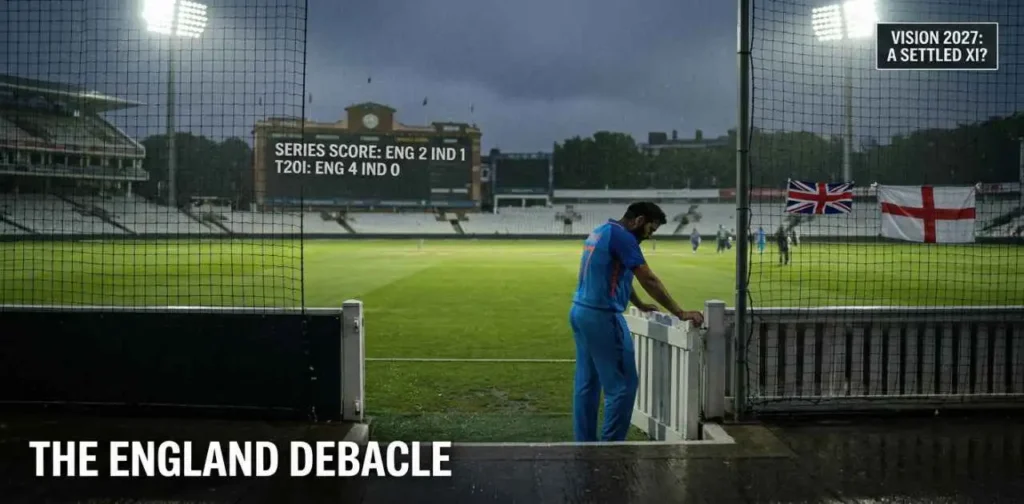
The recent India vs England series defeat has left fans and experts questioning the team’s future strategy. The dust has settled on India’s tour of England, and the verdict is out: it was a wake-up call that the Indian cricket management seemingly refuses to hear. A humiliating 4-0 whitewash in the T20Is followed by a 2-1 defeat in the ODI series has sent shockwaves through the fans.
While Rohit Sharma’s heroic century at Lord’s showed flashes of individual brilliance, individual milestones can no longer mask a deeper, structural rot. With the 2027 ICC ODI World Cup looming on the horizon, Team India looks like a ship steering blindly into a storm, lacking a core vision, a stable lineup, and clarity on its biggest icons.
The England Disaster: A Mirror to India’s Shortcomings
India’s tour of England was supposed to be a testing ground for transition, but it turned into a tactical disaster.
- The T20I Humiliation (4-0): For the first time in history, India lost four consecutive matches in a single T20I series. The team leaked its highest-ever runs in a T20I innings, looking completely out of depth against Harry Brook’s aggressive side.
- The ODI Bottleneck (2-1): Even in the 50-over format, the bowling unit looked toothless, allowing England to put up their highest-ever ODI total against India. Young fast bowlers leaked runs heavily, and the middle-order collapsed under pressure whenever the opening partnership failed.
This wasn’t just a series loss; it was a comprehensive outclassing that exposed India’s inability to win outside home conditions when subjected to modern, high-tempo cricket.
Where is the Vision for the 2027 World Cup?
When MS Dhoni built the team for the 2011 World Cup, the planning began in 2008. When England won in 2019, their revolution started in 2015. Yet, as we look at the current Indian setup heading toward 2027, there is an absolute lack of a long-term roadmap.
Instead of building a young, fearless core, the management is stuck in a loop of constant experimentation without any finality. Resting key players every alternate series and blooding youngsters without giving them a defined role has led to an environment where no one feels secure.
The Playing Eleven Conundrum: Too Many Choppings, Zero Fixes
If the 2027 World Cup were to start tomorrow, nobody—including the selectors—knows what India’s best playing XI looks like.
| Department | The Current Crisis |
| The Middle Order | Shreyas Iyer, KL Rahul, and Ishan Kishan continue to play musical chairs. Nobody knows who owns the crucial No. 4 and No. 5 slots. |
| The Bowling Transition | Beyond Jasprit Bumrah, the pace attack looks extraordinarily vulnerable. Youngsters like Arshdeep Singh and Prasidh Krishna have shown sparks but lack consistency in holding things down during the middle overs. |
| All-Rounder Vacuum | There is no viable, high-quality backup for the fast-bowling all-rounder slot, a flaw that England exploited ruthlessly. |
By constantly shuffling the pack, India is repeating the exact mistake they made before the 2019 and 2023 World Cups—entering a mega-event with an unsettled lineup.
The Elephant in the Room: The Rohit-Virat Dilemma
The biggest question mark over India’s 2027 vision is the future of its two greatest modern anchors: Rohit Sharma and Virat Kohli.
During the 3rd ODI against England, they achieved the historic milestone of becoming the first Indian pair to play 400 international matches together. Rohit hit a classic 138, and Kohli fought hard with a 74. But by the time the 2027 World Cup arrives in South Africa, Zimbabwe, and Namibia, both stalwarts will be touching 40.
This has created a massive state of limbo :
- Can they survive the physical toll? Playing grueling 50-over cricket in South African conditions at that age is a massive ask.
- The Transition Stall: Because the management doesn’t have a clear answer on whether Rohit and Virat will play in 2027, they are hesitant to give full leadership and batting responsibilities to the next generation, represented by Shubman Gill and others.
If they play, India risks taking an aging squad to a high-intensity tournament. If they are abruptly dropped later, the team will look completely hollow. The lack of a firm decision right now is crippling India’s future planning.
Conclusion: Time to Stop Papering Over the Cracks
BCCI and the team management need to understand that winning bilateral series at home on turning tracks will not win them global trophies. The karari haar in England must serve as a foundational turning point.
It is time for the selectors to sit down, draw up a strict blueprint, finalize a pool of 20 players, and take a definitive, transparent call on the future of the seniors. Without a concrete vision, the dream of lifting the 2027 ODI World Cup will remain just that—a dream.